Quick answer
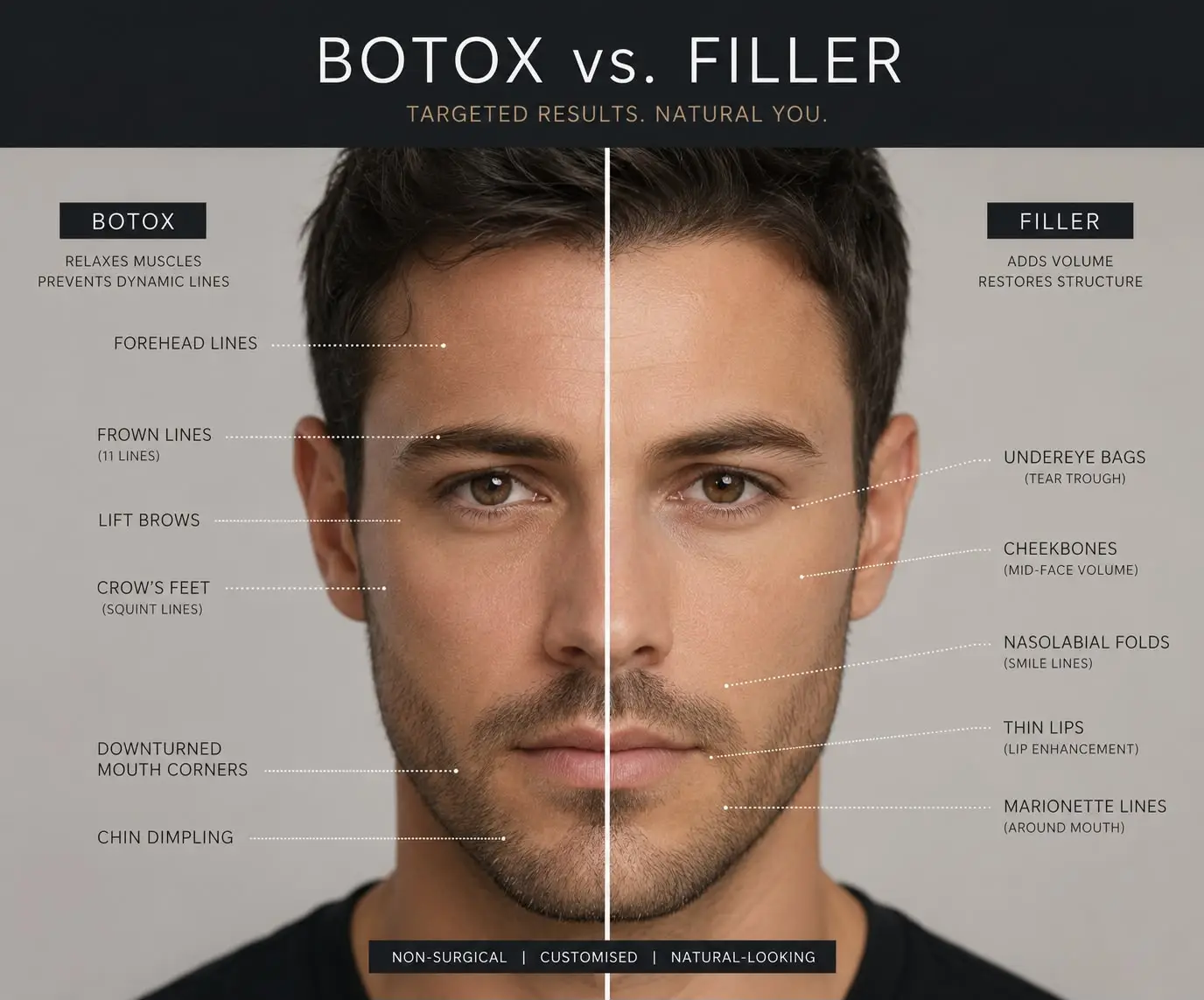
Botox and fillers are different clinical decisions, not rival products. Botulinum toxin is a prescription-only medicine that temporarily relaxes selected muscles to soften movement lines; dermal filler is a device that adds volume or contour. Which — if either — suits you depends on whether your concern is driven by movement or by lost volume, decided at assessment.
If fillers turn out to be the right route for you, see our full guide to dermal fillers in Shoreditch.
“Botox vs fillers” is a common search because both involve facial injections, but they are different clinical decisions. Botulinum toxin is a prescription-only medicine used to reduce activity in selected muscles temporarily. Dermal filler is an injectable medical device used to add volume or alter contour. Neither is automatically the answer to looking tired, lines, facial ageing or asymmetry—and many people need neither.
This guide compares mechanism, suitable concerns, risks, recovery, duration and cost at a London clinic. “Botox” is a brand name often used colloquially; Volt Cartel’s prescription and consent must identify the actual product proposed. The purpose of consultation is to diagnose the concern, not to sell a combination package.
Botulinum toxin vs dermal fillers at a glance
- Botulinum toxin: prescribed medicine; temporarily reduces selected muscle activity
- HA filler: injectable device; adds selected volume or contour
- Best choice: determined by diagnosis, anatomy, goals, risks and alternatives
- Results and duration: variable for both; no fixed timeline applies to every patient
- Reversal: toxin cannot be immediately reversed; hyaluronidase may break down HA filler but has limitations
- Price: use Volt Cartel’s current centrally managed pricing page
Contents
- How each treatment works
- Botox vs fillers comparison
- Which concerns may suit each?
- What consultation and treatment involve
- Can you have both?
- Cost comparison in London
- Side effects and risks
- Frequently asked questions

How Do Botulinum Toxin and Dermal Fillers Work?
Botulinum toxin (“Botox”)
Botulinum toxin type A reduces release of acetylcholine at the neuromuscular junction, temporarily weakening selected muscle activity. In aesthetic practice it may soften selected movement-related lines. It does not add volume, resurface skin or guarantee that a wrinkle disappears.
In the UK, botulinum toxin products are prescription-only medicines. Treatment requires an individual clinical assessment and prescription by an appropriate prescriber. Brand, licensed indication, dose, injection pattern and any off-label use must be discussed rather than hidden behind the generic word “Botox”.
Hyaluronic-acid dermal filler
HA filler is a manufactured, cross-linked gel placed in tissue to add selected volume or contour. Products differ in physical properties and indications. Filler does not switch off muscle activity, and it does not automatically lift a face or regenerate skin.
Hyaluronidase may be used off-label to break down HA filler. It is a prescription-only medicine and its availability does not make filler “fully reversible” or eliminate vascular, visual or delayed complications.
Botox vs Fillers: Key Differences
| Decision point | Botulinum toxin | HA dermal filler |
|---|---|---|
| Primary action | Temporarily reduces selected muscle activity | Adds selected volume or contour |
| Typical question | Is muscle movement driving the concern? | Is structural volume or contour the appropriate target? |
| Regulatory type | Prescription-only medicine | Injectable medical device; regulation differs |
| Onset and duration | Not immediate; variable by product, dose, area and response | Early volume change can be obscured by swelling; persistence varies |
| Immediate reversal | No antidote for an unwanted cosmetic effect | HA may respond to hyaluronidase, with important limitations |
| Serious risk examples | Unwanted weakness, ptosis, swallowing or breathing problems, distant toxin spread | Vascular occlusion, necrosis, visual injury, stroke, infection or delayed inflammation |
Which Concerns May Suit Each Treatment?
Movement-related lines
Selected forehead, frown or lateral-eye lines may be influenced by muscle activity and may be discussed for botulinum toxin. Static lines can have several contributors, and treatment must preserve necessary function and a proportionate expression.
Masseter or lower-face requests
Masseter treatment may be considered for selected muscle-related concerns, but jaw pain, tooth grinding and facial width are not one diagnosis. Dental, joint and neurological causes may need separate assessment. See the Masseter Botox London guide.
Lips, cheeks, chin or jawline contour
Filler may be considered where adding volume or projection is a proportionate way to address the concern. Product and amount should follow anatomy rather than a fixed millilitre package. Read the Dermal Fillers London guide and Lip Filler London guide.
Under-eye hollows or dark circles
Filler may soften a selected structural hollow. Pigmentation, swelling, laxity or fat prolapse may require another plan. Botulinum toxin does not replace missing volume. Read the tear trough filler guide.
The useful rule is not “movement equals toxin and everything else equals filler”. Real concerns can involve muscle, bone, fat, skin, vessels, pigment, teeth and health. A diagnosis may lead to one treatment, staged treatment, referral or no intervention.

What to Expect at Consultation
For toxin, the prescriber should assess anatomy and movement, the treatment goal, medical and medicine history, product information, contraindications, functional consequences and whether a proposed use is off-label. A fixed number of areas does not replace an individual prescription.
For filler, assessment covers anatomy, tissue, previous product, infection and dental history, medicines, allergies, alternatives and the vascular risk of the proposed area. Needle or cannula, product, plane and amount are clinical choices.
Preparation, aftercare and review should be individual. Do not stop prescribed medication because of a generic web timetable. Neither treatment has guaranteed “minimal downtime”: injection marks, redness, tenderness, headache, bruising or swelling can affect plans.
Can You Have Botox and Fillers Together?
They may be proposed in the same plan because they target different mechanisms. That does not prove a combined appointment is safer, more effective or more economical for every patient. Each component adds cost, consent points and potential adverse effects.
If both are recommended, ask what each is intended to change, why the timing was chosen, how swelling may affect assessment and what outcome would be expected from one treatment alone. “Full-face rejuvenation” should not become automatic product stacking.
Botox vs Fillers Cost in London
Prices vary by product, prescribed dose, treatment area, filler amount, practitioner and aftercare. Unverified “budget versus medical clinic” ranges have been removed because price alone does not prove legality, competence or safety.
Use Volt Cartel’s centrally managed pricing page for current anti-wrinkle and dermal filler figures. At consultation, ask what is included, whether review is included and whether the proposed figure could change after assessment.
Not sure which—if either—fits your concern?
Side Effects and Risks
Botulinum toxin
Possible effects include injection-site pain, redness, bruising, headache, asymmetry, unwanted brow or eyelid position and weakness in nearby muscles. The MHRA has warned that botulinum toxin can rarely spread beyond the injection site and cause serious swallowing or breathing difficulty; urgent medical help is required for those symptoms.
The MHRA strengthened its warnings for botulinum toxin products in July 2026 following rare reports of iatrogenic botulism, where the toxin’s effect can spread beyond the treatment area. Symptoms can appear from days up to four weeks after treatment — including difficulty swallowing, slurred speech, breathing difficulty or muscle weakness — and require immediate medical attention. Botulinum toxin should only be administered by a qualified medical professional using a product authorised for UK use.
Dermal filler
Common reactions include swelling, bruising, pain, tenderness and redness. Infection, nodules, migration, delayed inflammation, persistent swelling and discolouration can occur. Unintentional vascular injection or compression can cause necrosis, visual abnormalities including blindness, stroke and other permanent harm.
The two risk profiles are not meaningfully reduced to “which is safer?” Safety depends on product, indication, patient, dose or amount, anatomical area, practitioner, governance and access to urgent care.
Why Consult Volt Cartel in Shoreditch?
- Named medical-practitioner assessment and an individual toxin prescription where appropriate.
- Separate consent for medicine and device decisions rather than a bundled sales package.
- Assessment of prior filler, anatomy, movement, alternatives and the option not to treat.
- Visible current pricing, booking, aftercare and urgent contact pathways.
- Clinical-review ownership for public medical claims.
Clinical Review Note
“A request to look less tired or soften a line does not tell me which product is appropriate. I assess movement, volume, skin, existing filler and the functional consequences of treatment. The right answer can be toxin, filler, another option, staged care or no injection. If both are proposed, each needs a clear purpose.”
Frequently Asked Questions: Botox vs Fillers
What is the main difference between Botox and fillers?
Botulinum toxin temporarily reduces selected muscle activity; filler adds selected volume or contour. They have different regulation, consent, risks and uses.
Which lasts longer?
There is no universal answer. Toxin effect varies by product, dose, area and response. HA filler persistence varies by product, area and tissue and may outlast the visible cosmetic benefit.
Can both be done on the same day?
Sometimes, but same-day treatment is not automatically better. The clinician should explain indication, sequence, interaction of recovery and whether staging would improve assessment.
Which is better for forehead lines?
Movement-related forehead lines may be considered for prescribed toxin, but brow position, muscle balance, static skin change and functional risk need assessment. Filler in this vascular area is not a generic substitute.
Which is better for under-eye bags?
Neither may be appropriate. Hollowing, protruding fat, swelling, pigment and laxity need to be distinguished. Filler can worsen some presentations and toxin does not restore volume.
Are fillers reversible?
HA filler may respond to hyaluronidase, but dissolution can be incomplete or require further treatment. It cannot be relied on to reverse every vascular or ocular complication.
Is Botox reversible?
There is no immediate antidote for an unwanted cosmetic toxin effect. Effects are temporary, but duration and recovery from an adverse effect vary.
Which treatment is safer?
They have different risks. Toxin can cause unwanted weakness and rare systemic effects; filler can cause vascular, visual, inflammatory and infectious complications. The decision must be specific to the patient and proposed treatment.
How much does it cost to have both in London?
There is no responsible standard package price because toxin requires an individual prescription and filler amount depends on anatomy and product. Use current Volt Cartel pricing and confirm the plan at consultation.
Can people under 18 have cosmetic toxin or filler?
In England it is an offence, subject to limited exceptions, to give cosmetic botulinum toxin or filler injections to someone under 18 or to arrange or book them.
Key Takeaways
- Botulinum toxin is a prescribed medicine for selected muscle activity; filler is a device for selected volume or contour.
- The choice depends on diagnosis, not age or a simplistic movement-versus-volume slogan.
- Combination treatment needs two clear indications; “more comprehensive” is not automatically better.
- Neither has guaranteed timing, duration, downtime, symmetry or naturalness.
- Use current central pricing and a named clinical assessment before deciding.
Injectables Consultation in Shoreditch, London
Volt Cartel is at Ground Floor, 86–90 Paul Street, Shoreditch, London EC2A 4NE, accessible from Old Street, Liverpool Street and Shoreditch High Street.
Book a consultation | WhatsApp us
References
- Medicines and Healthcare products Regulatory Agency. Botulinum toxin: rare but serious risk of distant spread of toxin effect; seek urgent care for swallowing or breathing difficulty. MHRA Drug Safety Update.
- US Food and Drug Administration. Dermal Fillers (Soft Tissue Fillers): common and rare risks, including vascular occlusion, necrosis, visual abnormalities and stroke. FDA guidance.
- Kyriazidis I, et al. Adverse events associated with HA filler injection: systematic review of high-level evidence. PMID 37563436.
- Chatrath V, et al. Soft-tissue filler-associated blindness: systematic review. PMID 31321177.
- Master M, et al. HA filler longevity in the mid-face: review of 33 MRI studies. PMID 39015357.
- UK Government. Botulinum Toxin and Cosmetic Fillers (Children) Act 2021. GOV.UK guidance.
Named clinical claims and attribution require final practitioner approval before live publication. Individual results and recovery vary.
Frequently asked questions
What is the difference between anti-wrinkle injections and dermal fillers?
They do different jobs: botulinum toxin, known as anti-wrinkle injections, is a prescription medicine used to relax specific muscles that cause movement lines, while dermal fillers add volume or support structure. Which, if either, is appropriate is decided at a doctor-led assessment.
Which one do I need?
It depends on what you want to address, movement lines versus volume or contour, and often the answer is neither, one, or a combination. A consultation is used to give honest advice on what is realistic and appropriate for you.
What do they cost?
Cost depends on the treatment and plan, and guide prices are given at consultation. See our pricing for indicative figures.