
PRP Treatment London
PRP Treatment London at Volt Cartel in Shoreditch, London. Doctor-led consultation and tailored treatment planning for scalp, hairline, skin texture, skin quality, and treatment combinations planned after consultation.
Quick answer
PRP uses a small sample of your own blood, concentrated and injected, to support the skin or scalp. For hair loss the evidence is promising but still developing, and it is not a cure; for skin it is used for quality and texture. It is given as a course, and suitability is decided after assessment.
PRP Treatment at Volt Cartel
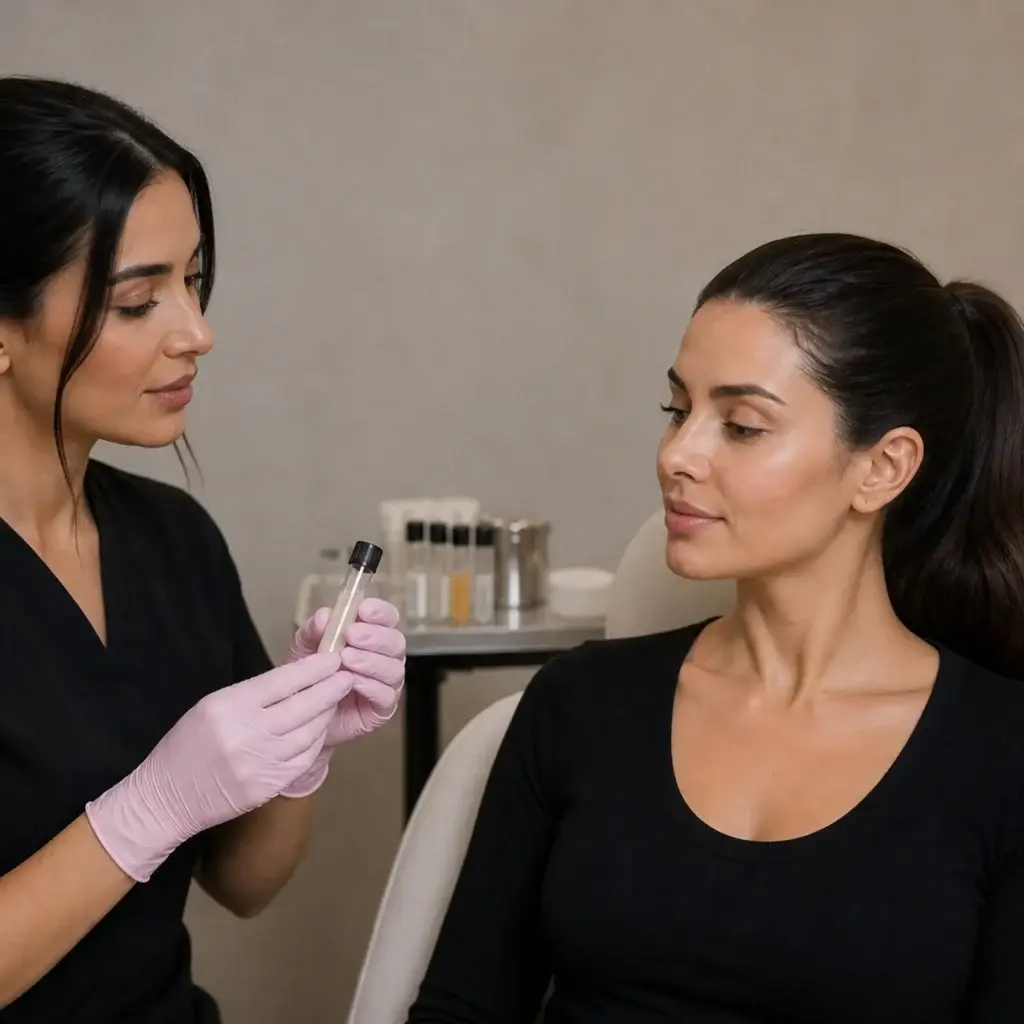
PRP (platelet-rich plasma) treatment at Volt Cartel uses the patient’s own concentrated plasma — extracted from a small blood draw and centrifuged to separate and concentrate the platelet fraction — injected back into the skin to stimulate growth factor release and tissue repair. The growth factors in platelets — PDGF, VEGF, TGF-β, and others — activate fibroblasts and keratinocytes, stimulating collagen production, angiogenesis, and cellular repair in the treated area. The aim is a gradual improvement in skin quality, hydration, and tissue regeneration that typically develops over weeks to months following treatment.
PRP at Volt Cartel is used for facial skin rejuvenation, under-eye quality improvement, scalp treatment for hair loss, and as a complement to other treatments such as Morpheus8, where the PRP is applied to the skin immediately after the device session to support the healing and regenerative response. The approach is tailored to the patient’s concern and the intended application area.
Results from PRP are gradual and require patience — a noticeable improvement is typically assessed at three months after the final session in a course of treatment rather than immediately after. A course of three sessions, four to six weeks apart, is standard for most indications.
What PRP treatment can help with
PRP treatment may be appropriate for patients seeking skin quality improvement — particularly hydration, luminosity, and fine-line softening driven by reduced collagen density; under-eye skin quality improvement where the periorbital area appears thin, crepey, or dehydrated; hair loss from androgenetic alopecia or telogen effluvium where scalp stimulation of hair follicle activity is a goal; or patients who want to use their own biology as a treatment vehicle rather than synthetic products. PRP is not a high-volume volumising treatment and is not the primary tool for structural volume loss.
How PRP treatment is planned
At consultation, your clinician will assess the area of concern, the degree of skin quality decline or hair loss, and whether PRP alone or in combination with a complementary treatment is more likely to meet the patient’s goal. For scalp PRP, a clinical assessment of the hair loss pattern, distribution, and likely cause is important to ensure PRP is targeting a condition that is likely to respond to follicular stimulation rather than one with a systemic cause that needs medical management.
A course of three sessions is standard, spaced four to six weeks apart. The response is assessed at three months after the final session, as the growth factor cascade and downstream collagen response take time to produce their full effect.
Suitability, safety, and treatment intensity
PRP is not suitable for patients who are pregnant or breastfeeding, have a blood clotting disorder or are taking anticoagulant medication, have active infection in the treatment area, have a haematological condition affecting platelet function, or have a low platelet count. Patients with anaemia or very low haematocrit may have a lower platelet yield from the blood draw, which affects treatment efficacy — this is discussed at consultation where relevant.
Because PRP uses the patient’s own blood, the risk of allergic reaction or immune rejection is extremely low. The main adverse effects are bruising at the injection sites, temporary redness, and mild swelling, all of which are expected and typically resolve within a week. The blood draw, centrifugation, and injection are all performed in the clinic under aseptic conditions. Suitability is confirmed at consultation, and your clinician will advise honestly if this treatment is not the most appropriate option for your concern.
What happens during PRP treatment
The appointment takes 45 to 60 minutes. A blood draw of 10 to 20ml is taken from the patient’s arm at the start of the session. The blood is placed in a centrifuge and spun to separate the platelet-rich plasma from red blood cells and other components — this takes approximately 10 minutes. The resulting PRP is activated and drawn up for injection.
For facial PRP, the plasma is injected into the dermis using a needle or cannula, targeting the areas of concern. For scalp PRP, injection is made at multiple points across the scalp in the area of thinning or loss. Topical anaesthetic is applied before all PRP injection sessions. After treatment, the area may appear red and slightly swollen for 24 to 48 hours. Written aftercare is provided.
Results, courses, and maintenance
PRP results are gradual and progressive. Most patients notice improvement in skin quality and hydration within four to six weeks of the first session, with more significant change accumulating over the course and the months following the final treatment. Scalp PRP results for hair loss are assessed at three months, as the follicular response and new hair growth cycle take time to produce visible improvement.
Maintenance sessions are recommended every six to twelve months depending on the indication and the patient’s individual response. PRP can be combined with Morpheus8, Profhilo, or other treatments as part of an integrated skin quality programme.
Pricing: PRP treatment pricing per session depends on the area being treated and the number of sessions in your protocol. A full quote is provided at your consultation.
Why choose Volt Cartel in Shoreditch
PRP at Volt Cartel is performed with equipment that produces a high-concentration platelet fraction and delivered by clinicians who understand the mechanism and the applications where it is genuinely useful. The consultation includes an honest assessment of whether PRP is likely to make a meaningful difference to the patient’s specific concern, and whether it should be used alone or alongside a complementary treatment for a stronger result.
The clinic is in Shoreditch, East London. PRP can be used as a standalone course or integrated with other treatments such as Morpheus8 or scalp treatment programmes.

Doctor’s Note
PRP is a treatment I use selectively — it works well in the right indications, and overselling it does patients a disservice. For hair loss, facial rejuvenation, and wound healing, the evidence base is solid when the preparation and injection technique are done correctly. The key variable is the quality of the PRP preparation: spin speed, tube type, and platelet concentration all matter for the final result.
— Dr Nino Rionidze, Lead Doctor & Clinic Manager, Volt Cartel Shoreditch
Potential benefits
- ✓Uses your own blood — no synthetic filler or foreign material
- ✓High concentration of growth factors that work to support collagen and tissue repair
- ✓Effective for skin quality improvement, fine lines, and hair loss
- ✓Can be combined with microneedling to support deeper delivery of growth factors
- ✓Minimal allergy risk as the serum is derived from your own blood
Concerns this treatment may be considered for
These links explain the concern in plain language. They do not confirm that this treatment is suitable for you.
What to expect
- Consultation and suitability assessment
- Review of goals, medical history, and previous treatments
- Treatment plan explained before anything is started
- Clinical photography or marking may be used where appropriate
- Treatment performed in a calm clinic setting
- Aftercare and review timing explained before you leave
Aftercare and downtime
- Avoid touching or massaging the treated area unless advised
- Avoid strenuous exercise, heat, and alcohol for the initial period advised
- Do not book facial treatments immediately after injectables
- Expect mild tenderness, swelling, or small marks to settle gradually
- Attend your review appointment if one is recommended
Questions about PRP Treatment London
What is PRP and how is it made?
PRP (platelet-rich plasma) is produced by drawing a small amount of your blood and centrifuging it to separate and concentrate the platelet-rich layer. Platelets contain high levels of growth factors — proteins that signal cell repair, collagen production, and tissue regeneration. This concentrated plasma is then applied or injected into the treatment area.
What can PRP treat?
PRP is used at Volt Cartel for skin quality improvement and rejuvenation, fine line reduction, hair loss treatment (applied to the scalp), and post-procedure recovery enhancement. It can be applied topically after microneedling or RF microneedling, or injected directly into the skin or scalp.
How many PRP sessions are needed?
For skin rejuvenation, a course of two to three sessions four to six weeks apart is common. For hair loss, three monthly sessions followed by maintenance every three to six months is the typical protocol. Single sessions can produce a noticeable glow and skin quality improvement, particularly when combined with microneedling.
When will I see results?
Initial improvement in skin glow and quality can be noticed within one to two weeks of treatment as the growth factors take effect. More a noticeable improvements in collagen density and fine lines develop over six to twelve weeks. Hair loss results take longer — typically three to six months to see meaningful density changes.
Does PRP hurt?
The blood draw is the same as a standard venepuncture and well tolerated by most patients. When PRP is applied after microneedling, the numbing cream applied before microneedling covers the PRP application. When PRP is injected into the scalp, topical numbing is applied beforehand.
What are the risks of PRP?
Because PRP is derived from your own blood, allergy or rejection risk is minimal. Common side effects include redness, bruising, and swelling at the treatment site, resolving within one to three days. Infection is rare when proper sterile technique is used.
Is PRP suitable for all skin types?
Yes. Because PRP relies on your body's own growth factors rather than light, heat, or a foreign substance, it is suitable for most skin types and Fitzpatrick tones, confirmed at consultation, without the chromophore-related risks associated with energy-based treatments.
Can PRP be combined with other treatments?
Yes. PRP is commonly combined with microneedling, RF microneedling, and other resurfacing treatments to enhance the regenerative response. It can also be used alongside injectable treatments, though sequencing matters. Your clinician will advise at consultation.
How much does PRP treatment cost?
PRP is usually given as a course, so cost depends on the number of sessions in your plan. Guide prices are published on our pricing page, and your clinician confirms the full cost and whether PRP is suitable for you at consultation, before treatment.
Discuss whether this treatment is suitable for you
A consultation reviews your goals, medical history, alternatives, realistic outcomes and the total cost before any treatment decision.