
Sun Damage Treatment London
Sun Damage Treatment London at Volt Cartel in Shoreditch, London. Doctor-led consultation and tailored treatment planning for sun spots, pigmentation, redness, rough texture, fine lines, and photo-ageing.
Quick answer
Sun damage — sun spots, uneven tone and texture — can often be improved with the right treatment, though ongoing sun protection is essential to keep results. The suitable option depends on your skin and is decided after assessment; any changing mark should be checked medically first.
Sun Damage Treatment at Volt Cartel
Sun damage treatment at Volt Cartel addresses the visible effects of cumulative ultraviolet exposure on the skin — including solar lentigines (sun spots), general dyschromia, telangiectasia, visible red vessels, surface roughness, and the dulled, uneven skin tone that develops over years of UV exposure. The goal is to restore a more even, clearer, and healthier-looking skin appearance using a combination of light-based treatment and medical-grade skincare.
The primary treatment for sun damage at Volt Cartel is Lumecca IPL, which uses intense pulsed light to target both melanin (pigmented damage) and haemoglobin (vascular change) in a single treatment session. Lumecca is a high-powered IPL platform, which means fewer sessions are typically needed to achieve a meaningful result compared with standard IPL devices. Chemical peels are also used as part of sun damage programmes where surface turnover and pigment reduction are priorities.
Suitability depends on Fitzpatrick skin type and the degree and character of the sun damage present. Your clinician will assess this at consultation before any treatment is confirmed.
What sun damage treatment can help with
Sun damage treatment may be considered for solar lentigines on the face, décolletage, chest, or hands; diffuse freckle darkening and proliferation; generalised uneven skin tone from chronic UV exposure; superficial redness and telangiectasia associated with photoageing; surface roughness and dulled complexion linked to UV-related collagen and epidermal change; or a general skin rejuvenation goal in patients whose primary driver has been sun exposure rather than ageing or volume change.
Sun damage accumulates progressively with each exposure — many patients do not notice the cumulative effect until their late thirties or forties, when patches of discolouration, fine lines, and textural irregularity become more visible simultaneously. Starting treatment early, or addressing existing damage before it deepens, typically gives a meaningfully better outcome than waiting until changes have become more established.
How sun damage treatment is planned
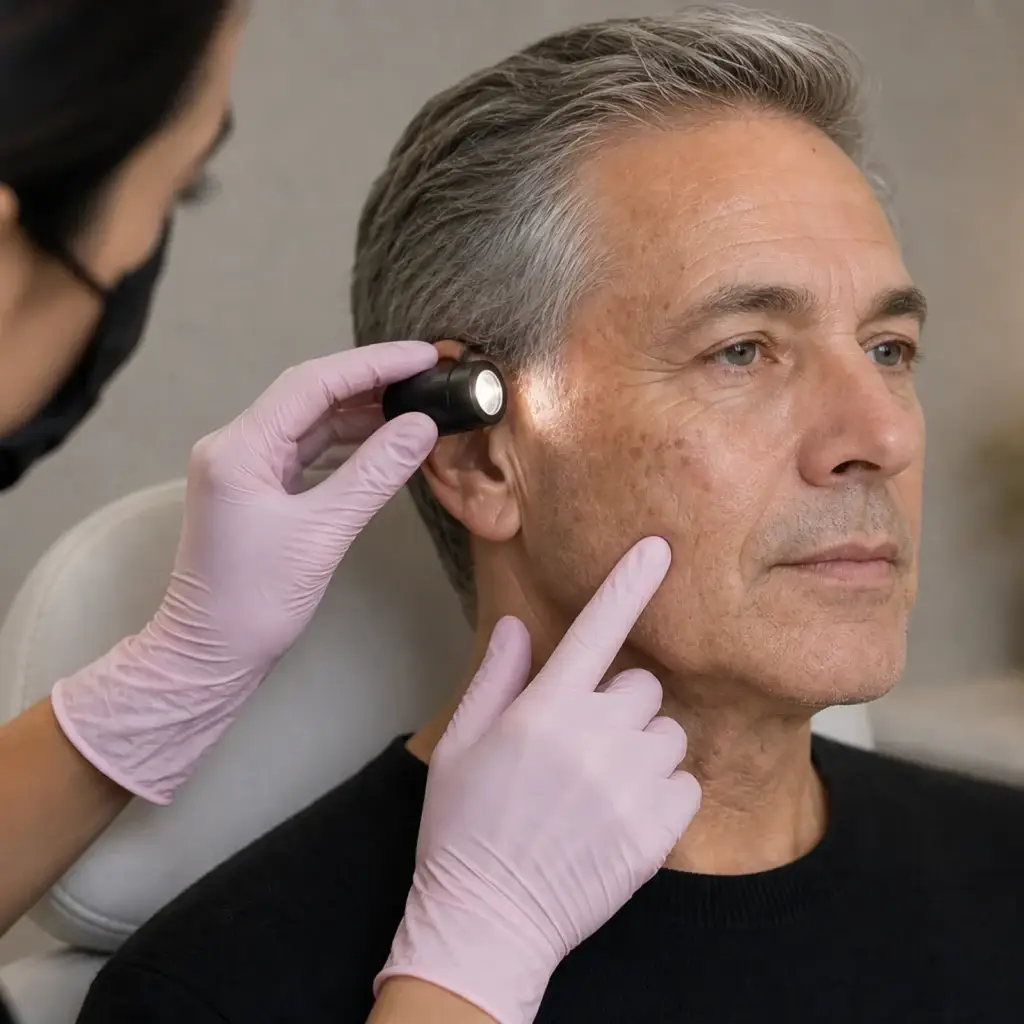
At consultation, your clinician will assess the character and distribution of your sun damage, your Fitzpatrick skin type, your recent sun exposure, and whether any of the pigmented lesions present require monitoring or dermatological assessment before aesthetic treatment is initiated. Any lesion that has features inconsistent with a benign solar lentigo — including irregular border, colour variation, or recent change — will be referred for dermatological review rather than treated.
The treatment plan typically involves a course of Lumecca IPL sessions — usually two to four — spaced four to six weeks apart, with assessment at each session to gauge response. Medical-grade SPF 50 and a vitamin C serum are recommended throughout the course to support the result and prevent new UV-driven damage.
Suitability, safety, and treatment intensity
Lumecca IPL for sun damage is not suitable for patients who are pregnant or breastfeeding, have an active tan, are taking photosensitising medications, or have Fitzpatrick skin type V or VI where the risk of IPL-induced post-inflammatory pigmentation is significant. Patients must attend for treatment without a tan — active melanin in the epidermis from recent UV exposure competes with the targeted chromophore and increases adverse reaction risk.
Pigmented lesions that do not have a clear clinical history of sun exposure, or that have features of clinical concern, are referred for dermatological assessment before any light-based treatment is applied. The aesthetic clinic is not the appropriate setting for the assessment of atypical pigmented lesions. Suitability is confirmed at consultation, and your clinician will advise honestly if this treatment is not the most appropriate option for your concern.
What happens during sun damage treatment
Lumecca IPL appointments take 30 to 60 minutes depending on the area being treated. The skin is cleansed, a cooling gel applied, and protective eyewear provided. Light pulses are delivered systematically across the treatment area — most patients describe a heat flash and mild snapping sensation with each pulse. Immediately after treatment, treated pigmented spots typically appear slightly darker than before the session; this indicates the melanin has been targeted and the lesion will shed over the following five to fourteen days.
Redness in the treatment area is normal following IPL and settles over a few hours to one to two days. Aftercare is provided in writing and includes strict sun avoidance, SPF 50 daily, and avoidance of heat triggers for 48 hours after treatment.
Results, courses, and maintenance
Sun damage responds well to Lumecca IPL in suitable skin types, with many patients seeing visible improvement in spot clarity and skin tone after the first session. Progressive improvement occurs over the course of treatment, and the full result of a course is typically assessed four to six weeks after the final session once all treated lesions have shed and the skin has completed its response cycle.
Without daily sun protection, sun damage returns over time. Maintenance treatment is recommended annually for most patients who continue to have UV exposure, and the degree of maintenance needed reduces significantly with consistent SPF use. Daily SPF 50 is considered a non-negotiable part of any sun damage management plan.
Pricing: Sun damage treatment pricing per session depends on the extent of the area being treated and the technology recommended. A full quote is provided at your consultation.
Why choose Volt Cartel in Shoreditch
At Volt Cartel, sun damage treatment begins with a proper skin assessment rather than the assumption that all pigmented marks are safe to treat. Clinicians assess lesion character before treating and refer any atypical lesions for dermatological review as a priority over aesthetic improvement. Treatment plans are built around the patient’s skin type, the character of the damage, and an honest discussion of what is achievable and how to maintain it.
The clinic is in Shoreditch, East London, with Lumecca IPL and medical-grade peel options available for sun damage programmes.

Doctor’s Note
Years of cumulative sun exposure show up differently on different skin types, but the common thread is irregular pigmentation, background redness, textural changes, and early laxity. I approach sun damage treatment as a phased plan rather than a single intervention: address the surface pigment first, then target any residual vascular component, then work on texture and tone. The order matters because some treatments that improve one element can temporarily affect the other.
— Dr Nino Rionidze, Lead Doctor & Clinic Manager, Volt Cartel Shoreditch
Potential benefits
- ✓Clears sun spots, age spots, and diffuse pigmentation from UV exposure
- ✓Reduces redness and vascular changes associated with chronic sun damage
- ✓Calibrated IPL settings matched to skin tone and damage distribution
- ✓Progressive clearance over two to four weeks after each session
- ✓Improves overall skin tone and clarity across treated areas
Concerns this treatment may be considered for
These links explain the concern in plain language. They do not confirm that this treatment is suitable for you.
What to expect
- Consultation and suitability assessment
- Review of goals, medical history, and previous treatments
- Treatment plan explained before anything is started
- Clinical photography or marking may be used where appropriate
- Treatment performed in a calm clinic setting
- Aftercare and review timing explained before you leave
Aftercare and downtime
- Use gentle skincare for the period advised
- Avoid active skincare until your clinician confirms it is suitable
- Wear high-factor SPF daily and avoid intentional sun exposure
- Do not pick, scrub, or exfoliate healing skin
- Follow the review and maintenance plan recommended for your skin
Questions about Sun Damage Treatment London
What does sun damage treatment target?
Sun damage treatment at Volt Cartel targets the visible effects of cumulative UV exposure including solar lentigines (sun spots), age spots, freckles, diffuse brown pigmentation, redness, and telangiectasia. The light energy breaks down the pigment and vessels responsible for these changes.
How does IPL treat sun damage?
Lumecca IPL delivers intense pulsed light filtered to wavelengths absorbed by melanin (brown pigment) and haemoglobin (red pigment). The light energy heats and destroys the target cells, which the body then clears over the following days and weeks. The result is progressively clearer, more even skin tone.
How many sessions are needed?
Most patients with moderate sun damage see meaningful improvement after two to three sessions three to four weeks apart. More extensive sun damage may benefit from additional sessions. Your clinician will advise on the recommended course at consultation.
What is the downtime?
Sun spots and pigmentation typically darken immediately after treatment — this is a normal response. They then flake or shed over seven to ten days. Some redness on the day of treatment is expected. Most patients can continue with their normal activities and cover with makeup from the next day.
Is sun damage treatment suitable for all skin types?
IPL for sun damage is most effective and safest on Fitzpatrick types I to III. For darker skin tones, there is an increased risk of treating surrounding melanin. Skin tone is assessed before every session and settings are calibrated accordingly. For darker skin types, alternative approaches may be recommended.
What aftercare is needed?
Strict sun avoidance and daily SPF50 use are essential during and after a course of treatment. Sun exposure between sessions can cause pigmentation to return and may cause an adverse reaction. Your clinician will provide full aftercare guidance before and after each session.
Can sun damage come back?
Existing sun damage can be cleared, but further UV exposure will cause new damage to develop. Long-term SPF use, sun avoidance, and protective measures are essential to maintain results and prevent new spots from forming.
Does sun damage treatment hurt?
Most patients describe each IPL pulse as a brief warm snap on the skin. A cooling gel is applied throughout treatment. The sensation varies by area — bony areas such as the temple and nose can be more sensitive. Overall most patients find the procedure well tolerated.
What are the risks?
Common side effects include temporary redness and darkening of treated spots. Rarer risks include hyperpigmentation or hypopigmentation if settings are not calibrated correctly for skin type, and superficial skin changes. These risks are minimised by Fitzpatrick assessment and correct technique.
How much does sun damage treatment cost?
Treating sun damage depends on the method and how many sessions your skin needs, so there is no flat price. Guide prices are on our pricing page, and after assessing your skin at consultation your clinician confirms the full cost before treatment begins.
Discuss whether this treatment is suitable for you
A consultation reviews your goals, medical history, alternatives, realistic outcomes and the total cost before any treatment decision.